+91 99403 08129 techmanpower31@gmail.com
Products & Services

Solar Home System

Customized solar power solutions designed for every Indian household.

Tech Solar has in-depth knowledge of domestic and residential customer needs. The solar system needs to be designed and installed after accounting for the kind of household appliances, the usage pattern of the domestic customers, site conditions, and the prevailing EB solar policy. Our solar solutions are customized for these domestic needs, be it Individual-houses, Apartments, Villas, Hostels, Ashrams, etc. With enriched industry experience and knowledge specific to Indian households, we are providing an excellent range of Home Solar Power Systems. Be it Off-Grid, On-Grid, Hybrid, or any other combination, we have customised and optimal solar power solutions for all household applications.

The solar system is suitable when:

OFF-GRID SOLAR POWER SYSTEM FOR HOME

An Off-Grid system comes with a battery bank and uses grid power (if available) only as backup. During the day, the solar power generated from solar panels powers the household appliances and the excess power is stored in batteries. The power from the batteries is used at night. Tech Solar's off-grid systems are designed for 24/7 power from solar on a sunny day. During rainy days and/or higher-than-usual electricity usage days, the grid power is used as backup. Its main objective is to provide 24/7 power and also EB bill savings.

The Off-Grid solar system is suitable when:

  • The customer is not connected to EB grid
  • There is no concept of net-metering in that area
  • The customer does not have a good EB connection
  • The customer wants to run appliances only on solar without any grid dependency
Working Principle
  1. The solar panels receive sunlight during the day. The DC power generated is fed to the solar charge controller, which regulates the charging voltage and current delivered to the battery bank.
  2. The battery bank stores the energy harvested from solar panels. When the sun is shining, it powers the connected appliances during the day at the same time charging the batteries.
  3. The solar inverter (PCU) converts the stored DC battery power into usable AC power for home appliances and runs all connected loads.
  4. At night, the batteries discharge and supply power through the inverter to the household loads without any interruption.
  5. The EB grid is connected as a backup source. Whenever the battery reaches a low-voltage cut-off level, the system automatically switches to grid power to recharge batteries and supply the load.

Note: The system is designed such that the battery is used only when solar power is not available. The EB switch-over happens automatically and is seamless, ensuring uninterrupted power at all times.
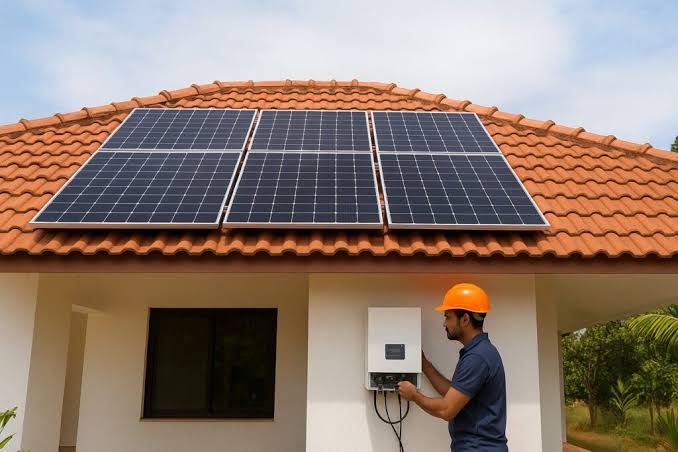
Off-Grid Solar System Diagram
Key Components
  • Solar PV Panels
  • Solar Charge Controller (MPPT/PWM)
  • Battery Bank (Lead Acid / Lithium)
  • Solar PCU / Inverter
  • EB Grid (Backup only)

ON-GRID SOLAR POWER SYSTEM FOR HOME
On-Grid Solar System Diagram
Key Components
  • Solar PV Panels
  • On-Grid / Grid-Tie Inverter
  • Bi-Directional Energy Meter
  • AC Distribution Board
  • EB Grid Connection

An On-Grid solar power system is directly connected to the public electricity grid. It does not require battery storage as it uses the grid as a virtual battery. The solar power generated is consumed directly by the household, and any excess electricity is exported back to the grid. The electricity exported earns credits through net metering, which are adjusted against future EB bills. On-Grid systems are the most cost-effective option since there are no batteries involved.

The On-Grid system is most suitable when:

  • You have a stable and uninterrupted EB power supply
  • Net metering facility is available in your area
  • You want to minimize upfront investment (no batteries)
  • You are eligible for government subsidies under PM Surya Ghar scheme
Working Principle
  1. The solar PV panels generate DC electricity during sunlight hours. This DC power is fed directly into the on-grid solar inverter.
  2. The grid-tie inverter converts DC to AC power, synchronising it with the grid frequency and voltage to make it compatible with household appliances.
  3. The converted AC power is first used to power the household loads — lights, fans, AC, refrigerator, etc. The household consumes this free solar energy directly.
  4. If the solar power generated is more than the current household consumption, the surplus power is automatically exported to the EB grid through the bi-directional meter.
  5. At night or on cloudy days, when solar power is insufficient, the system draws power from the EB grid normally. The bi-directional meter records both import and export units for net metering settlement.

Note: The on-grid system shuts down automatically during a grid failure (anti-islanding protection), ensuring the safety of TANGEDCO linemen working on the grid. This is a mandatory safety requirement for all grid-tied solar systems.


HYBRID SOLAR POWER SYSTEM FOR HOME

A Hybrid solar power system combines the best features of both Off-Grid and On-Grid systems. It includes battery storage as well as a connection to the utility grid. When solar power is available, it powers the household loads and simultaneously charges the batteries. Excess energy after charging the batteries is exported to the grid. When solar is not available (night or cloudy days), the system first uses stored battery power. The grid acts as the last resort, used only when batteries are also depleted. This makes the Hybrid system the most reliable and self-sufficient home solar solution available.

The Hybrid system is best suited when:

  • You want both battery backup and net metering benefits
  • You face moderate to frequent power outages
  • You want maximum energy independence with a safety net from the grid
  • You are planning a future-ready solar system for your home
Working Principle
  1. Solar panels generate DC electricity. The hybrid inverter manages three energy sources simultaneously — solar panels, battery bank, and the EB grid — using intelligent energy management algorithms.
  2. During the day, solar power first meets the household demand. Surplus solar power charges the battery bank until it is fully charged (Priority: Load → Battery → Grid Export).
  3. Once batteries are fully charged and solar continues to produce surplus, the excess is exported to the grid and credits are earned through net metering.
  4. After sunset, the battery bank takes over and powers the household loads through the hybrid inverter without any interruption or manual switching.
  5. Only when the battery level falls to a critical threshold does the system draw from the EB grid to power loads and recharge the batteries, completing the full energy cycle.

Note: The hybrid inverter continuously monitors the state of charge (SOC) of the battery and the load on the system to make smart switching decisions. The entire process is fully automatic with zero manual intervention required.

Hybrid Solar System Diagram
Key Components
  • Solar PV Panels
  • Hybrid Solar Inverter
  • Battery Bank (Lithium / Lead Acid)
  • Bi-Directional Energy Meter
  • EB Grid Connection
Why Tech Solar?

We Make Solar Simple

Free Site Survey

Our experts visit your home and assess the best solar solution at no cost.

Hassle-Free Subsidy

We handle all paperwork for government subsidy on your behalf.

20-Year Panel Warranty

Top-quality panels with manufacturer-backed long-term warranty.

After-Sales Support

Dedicated support team available for maintenance and service calls.

Ready to Go Solar?

Get a free consultation and custom quote for your home today.

Get Free Quote Call Now